Seven Days at 55 MPH: I Gave Up the Interstate and Only Regretted It Twice
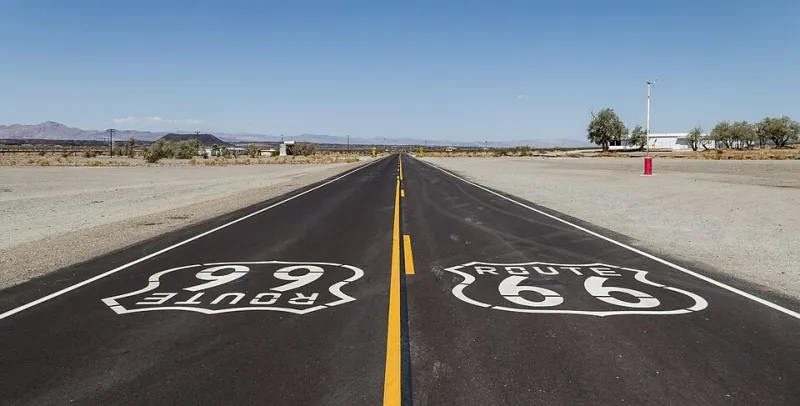
Photo: Dietmar Rabich, CC BY-SA 4.0, via Wikimedia Commons
Somewhere outside Amarillo, a sign on I-40 promised El Paso in four hours and change. I took the exit instead — the one for US-285, or maybe US-87, honestly by day three they'd blurred together — and what followed was the longest, slowest, most argument-winning week of my driving life.
The premise was simple, possibly stupid: for seven days, the interstate was off-limits. Anywhere the big slab of asphalt went, I'd take the older, narrower road running alongside it. Same destination, same region, radically different experience. Think of it as the highway equivalent of pruning a bonsai — you're not adding anything, just cutting away the fastest parts until something interesting takes shape.
The Math Nobody Wants to Do
Let's get the numbers out of the way, because every road trip argument dies on this hill. Over roughly 1,400 miles, the two-lane version of my route cost me about four and a half extra hours of total drive time. That's it. Four and a half hours, spread across a week, or roughly 40 minutes a day — less time than you spent yesterday watching a video of someone else's dog.
Fuel costs came out nearly even. Two-lanes are often a few mph slower, but so is idling behind a semi doing 68 in a 70. Gas was marginally cheaper in the small towns, mostly because I was buying it in towns where gas stations still compete. Food, though, is where the ledger flips. On the interstate, I'd have eaten three sad combos and a bag of something called "road trip mix." On the two-lane, I ate chicken-fried steak in Clarendon, Texas, and pie in a café where the pie case had seniority over the waitress.
What You Actually See at 55
Here's the thing about 75 mph: it's a blur with lane markings. At 55, the world resolves into detail. I saw a hand-painted sign for a rattlesnake museum. I saw a grain elevator with a town's name spelled out in letters visible from space, presumably. I saw a man mowing his lawn next to a highway in the panhandle, and we both waved, because at two-lane speeds, waving is still legal and expected.
The interstates were engineered to hide the country. They cut through cuts, bridge over draws, and present you with a highlight reel of embankments. The old highways, built before bulldozers got ambitious, follow the terrain. They curve around hills instead of decapitating them. You feel the land because the road refuses to let you ignore it.
The Towns Are the Point
My rule was simple: no chains, and gas up where the pump has a name on it. That rule fed me better and cheaper all week. It also meant that by day four, I knew things. Real things. The café owner in Tucumcari told me which motel neon had actually been restored and which was just lit. A guy at a feed store in Kansas — don't ask how I ended up in Kansas, the route had opinions — gave me directions that included two barns and a grudge.
You cannot get this from an exit ramp. Exit ramps give you the same six businesses in the same six states. Two-lanes give you a town where the water tower, the church, and the gossip all share a parking lot.
The Two Regrets, Honestly Reported
I promised honesty, so: regret number one hit around 4 p.m. on day two, somewhere in West Texas, when the two-lane ran dead straight for 40 minutes and my podcast hit an ads section. There is no scenery so beautiful it can't be improved by a passing lane. Regret number two was rain — two-lanes in a downpour mean slow traffic behind grain trucks and no shoulder to speak of. If you go, build weather patience into the plan.
How to Run Your Own Experiment
You don't need a week. Start smaller. Pick one interstate corridor you've driven a dozen times, then find the US highway that predates it — they almost always exist, running parallel like a disappointed older sibling. Take it for a single 100-mile stretch. Compare notes.
A few practical notes from the trenches: download offline maps, because cell service on the old roads is a suggestion, not a promise. Fuel up at half a tank, not a quarter. And give yourself permission to stop for anything — the giant rocking chair, the historical marker, the dog asleep in the middle of Main Street. On the interstate, stopping costs twenty minutes and an interchange headache. On the two-lane, stopping costs a U-turn and a story.
The extra four and a half hours? I've decided that's not the price of the trip. That's the trip. Everything else was just the driving between stops.
So take the detour. The interstate will still be there when you get back, same as ever, promising El Paso in four hours and change. It always overestimates. You'll know that soon enough.