Plan Around the Moon, Not the Museum: Your Dark-Sky Road Trip Playbook
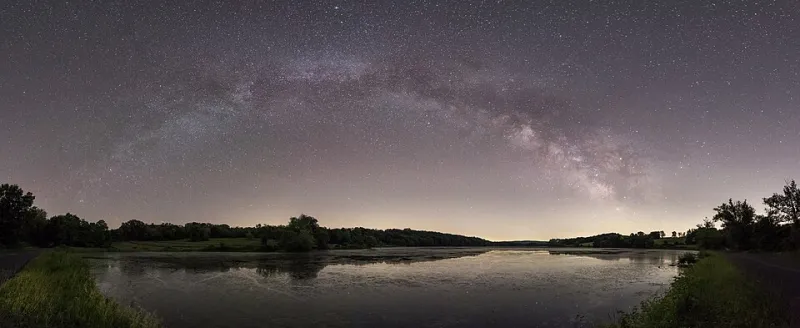
Photo: Juliancolton, CC BY-SA 4.0, via Wikimedia Commons
Most people plan road trips around things you can see in daylight: dinosaur footprints, world's largest ball of twine, that one giant Paul Bunyan holding a hot dog. Amateurs. The best show in America right now happens after the sun punches out, and 2025 is prime time to catch it.
We're at the peak of the solar maximum — the rowdiest stretch of the sun's 11-year mood cycle — which means auroras are crashing parties as far south as Missouri and Utah. Combine that with a new moon, a tank of gas, and a stretch of highway far from any city's glow, and you've got the cheapest light show on Earth.
Here's the Bonzivista method: build the trip around the lunar calendar, not the attraction list.
Why the Moon Is Your New Travel Agent
Here's the dirty secret of stargazing: the moon is a gorgeous jerk. A full moon is lovely for a picnic, but it washes out the Milky Way like a flashlight in a movie theater. If your goal is stars — and this year, auroras — you want to travel during the new moon, when the sky goes properly black.
So open a lunar calendar before you open a map. Pick a new moon, give yourself a three-night window on either side (the sky stays dark for roughly a week), and only then start routing. It flips trip planning on its head: instead of asking "what's along the way?" you ask "where's the darkest pavement I can reach by Friday?"
Corridor One: Big Bend, Texas
The Big Bend region has some of the darkest measured skies in the Lower 48 — we're talking Bortle 1, the sky equivalent of a tasting-menu restaurant: nothing between you and the raw product.
Drive US-118 from Alpine down to the park gate, and time your arrival for dusk. There's minimal development the whole way, which is exactly the point. Base yourself in Terlingua or Study Butte, where the local lodging scene has quietly figured out that "no outdoor lights after 10 p.m." is a feature, not a rule. Some cabins even advertise star beds — open-air sleeping platforms so you can watch the Milky Way wheel overhead without so much as sitting up.
Pro move: the park occasionally closes the Chisos Basin Road to vehicle traffic on astronomy nights. Check the ranger schedule. Driving less, seeing more — the bonsai philosophy applies to headlights, too.
Corridor Two: Cherry Springs, Pennsylvania
Yes, Pennsylvania. The East Coast is a light-pollution swamp, but Cherry Springs State Park is the exception that proves the rule — a 48-acre pocket of inky sky surrounded by 230,000 acres of dark forest.
The play here is a two-lane tour of PA-44 and PA-6 through the Pennsylvania Wilds, a corridor so committed to the bit that the town of Coudersport passed lighting ordinances to protect the view. Local motels cater to the astronomy crowd, and the park's overnight astronomy field requires reservations during peak season — worth it, because the Milky Way here casts a visible shadow. Bring a red-headlamp. Bring two, because someone in your car forgot theirs.
Corridor Three: The Utah Dark Sky Highway
Utah has more certified International Dark Sky Parks than anywhere else, and they're strung together like beads on a very dark necklace. Route 24 through Capitol Reef to the Highway 12 byway toward Bryce is the crown jewel stretch.
Torrey, Utah, is the unsung hero — a town of under 200 people that retrofitted its streetlights to be dark-sky compliant. Pull over at any of the highway's overlooks after 10 p.m. and you'll understand why. Bonus: solar-maximum auroras have been spotted from southern Utah in 2025, which locals will tell you is roughly as common as a polite merge in a national park parking lot.
The Stargazer's Packing List
- Red-light headlamp. White light ruins everyone's night vision for 30 minutes. Be the villain at your own peril.
- A star app with offline maps. Cell service in dark places is, by definition, nonexistent.
- Layers. Desert and mountain nights get cold even in summer. Ask the shivering person wrapped in a beach towel — that was us.
- A thermos and snacks. Astronomical twilight waits for no one's stomach.
- Patience. Give your eyes a full 20 minutes of darkness. The sky's second act is always better.
Timing Is Everything (and Then Some)
The 2025 solar maximum means aurora forecasts are worth checking like weather. NOAA's aurora dashboard will tell you when a solar storm is inbound — and when one lines up with a new moon and a clear forecast in a Bortle 1 zone, drop everything and drive. These windows are rarer than an open rest-stop bathroom at midnight.
The whole point of the astro-road trip is the same lesson we keep learning on every detour: the best sights don't show up on the itinerary. They show up when you plan around something bigger than yourself — in this case, a ball of burning gas 93 million miles away throwing a party, and a rock 238,000 miles away politely agreeing to stay home.
Check the lunar calendar. Fill the tank. Keep the lights off.