Scrambled, Covered, and Code Red: What the Waffle House Index Knows About the Road Ahead
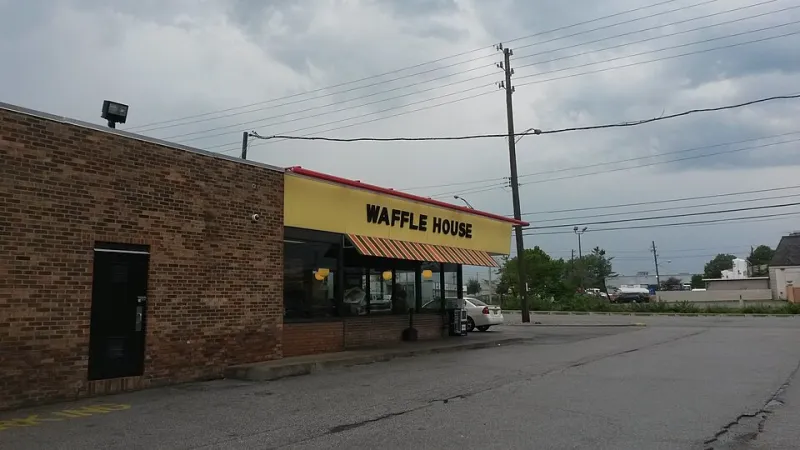
Photo: Yonikasz, CC BY-SA 4.0, via Wikimedia Commons
Somewhere between Tulsa and Oklahoma City, a hurricane researcher named Chuck Watson had a revelation: the federal government has satellites, radar arrays, and supercomputers, but the truest measure of how bad things are in a storm zone is whether the Waffle House on the frontage road is selling waffles.
He wasn't joking. FEMA adopted the idea, and the Waffle House Index is now genuine informal doctrine. If the waffle house is open with a full menu, the damage is minor. Limited menu? Power's out, things are dicey. Closed entirely? Get out. If a restaurant famous for never closing has closed, the situation has graduated from "weather event" to "weather problem."
For road trippers, this is more than trivia. It's the tip of a whole iceberg of unofficial emergency wisdom — folk signals that don't come with an alert on your phone but absolutely come in handy when you're 200 miles from home and the sky turns the color of an old penny.
The Menu Is the Message
First, learn to read a Waffle House like a meteorologist. The chain's legendary disaster preparedness — backup generators, corporate protocols, managers trained to reopen fast — makes it a better barometer than most gas station TVs. It's built to be the last light on and the first light back on.
So when you roll into a small Southern town and see the waffle house running on a limited menu, don't order the pecan waffle you were craving. Order the information. Limited menu means the supply chain or the power grid is limping. Ask the waitress what's going on. Waitresses are the original emergency broadcast system.
Gas Prices Are a Forecast You Can Read at 70 MPH
Here's one nobody teaches you in driver's ed: fuel prices spike before storms, not after. When a hurricane's still two days off the coast, stations along the evacuation routes start creeping up — and sometimes they simply run dry, because everyone between you and the coast had the same idea a day earlier.
The road-tripper's rule: if you're anywhere near a named storm and you see a line of cars with out-of-state plates at a gas station, top off your tank immediately. Half a tank is not a tank. In genuinely bad conditions, fuel is range, range is options, and options are safety. The detour you can afford is the detour you have gas for.
Small-Town Sirens: They're Not Always What You Think
That siren you hear in a rural town might be a tornado warning. It might also be the noon whistle, a volunteer fire department callout, or a test that happens every first Tuesday of the month. The folklore here is simple but real:
- A steady tone in most tornado-prone states means take shelter now.
- A siren at exactly noon in a farm town is probably just telling the corn it's lunchtime.
- Short bursts or a rising-falling pattern can mean fire department callout in volunteer communities.
The practical move: if you hear a siren and it's not noon, pull into a gas station or café and ask. Nobody in a small town minds being asked about a siren. It's the local equivalent of "how about this weather?" — except the answer actually matters.
When the Bars Disappear: Your Dead-Zone Playbook
Cell service dies exactly when you need it most, because towers fail, networks jam up, and — this is the part that surprises people — text messages often get through when calls don't. Texts require a fraction of the bandwidth. If your call won't connect mid-storm, send a text to your emergency contact with your location and plan, then put the phone down to save battery.
Other dead-zone wisdom worth keeping in the glovebox:
- Download your offline maps before you leave, not during the storm. Offline maps work with zero signal; the search bar does not.
- A car charger is not optional equipment. Cold snaps and idling in parking lots drain batteries and phones in equal measure.
- Local AM radio is the truest emergency broadcast. The signal travels far at night, and small-town stations keep broadcasting through outages when your streaming app gives up. It's why we keep a cheap battery radio in the trunk.
The Gas Station as Weather Station
Truckers are the most informed people on any highway, and you can borrow their intel for free. If the truck stop is full of rigs parked nose-out, pointed away from the weather, that's not a coincidence — those drivers are positioning to leave fast or waiting out something they know is coming. Buy a coffee, listen to what's being said near the counter, and check the radar on the TV that's always, always on.
Similarly: when locals at a gas station start talking about "the creek coming up" or "last time it flooded like this," that's your sign that the scenic two-lane through the low valley might not be scenic for long. Never drive through standing water, no matter how confident your suspension feels about it.
Write Your Own Index
The beauty of the Waffle House Index is that it's a signal hiding in plain sight — a piece of everyday American roadside culture that doubles as data. Every road tripper eventually builds their own version. Maybe yours is: if the bait shop is boarded up, don't take the coastal route. Or: if the church marquee says 'Pray' and nothing else, take the highway instead of the county road.
The point isn't paranoia. It's that the best travelers pay attention to the same things everyone else ignores. The waffle house isn't just where you get dinner at 11 p.m. It's a weather service with a griddle. Tip well — the staff there have seen things.
And if you ever find yourself in a waffle house that's closed, do what the index says: the pancakes can wait. Your exit can't.